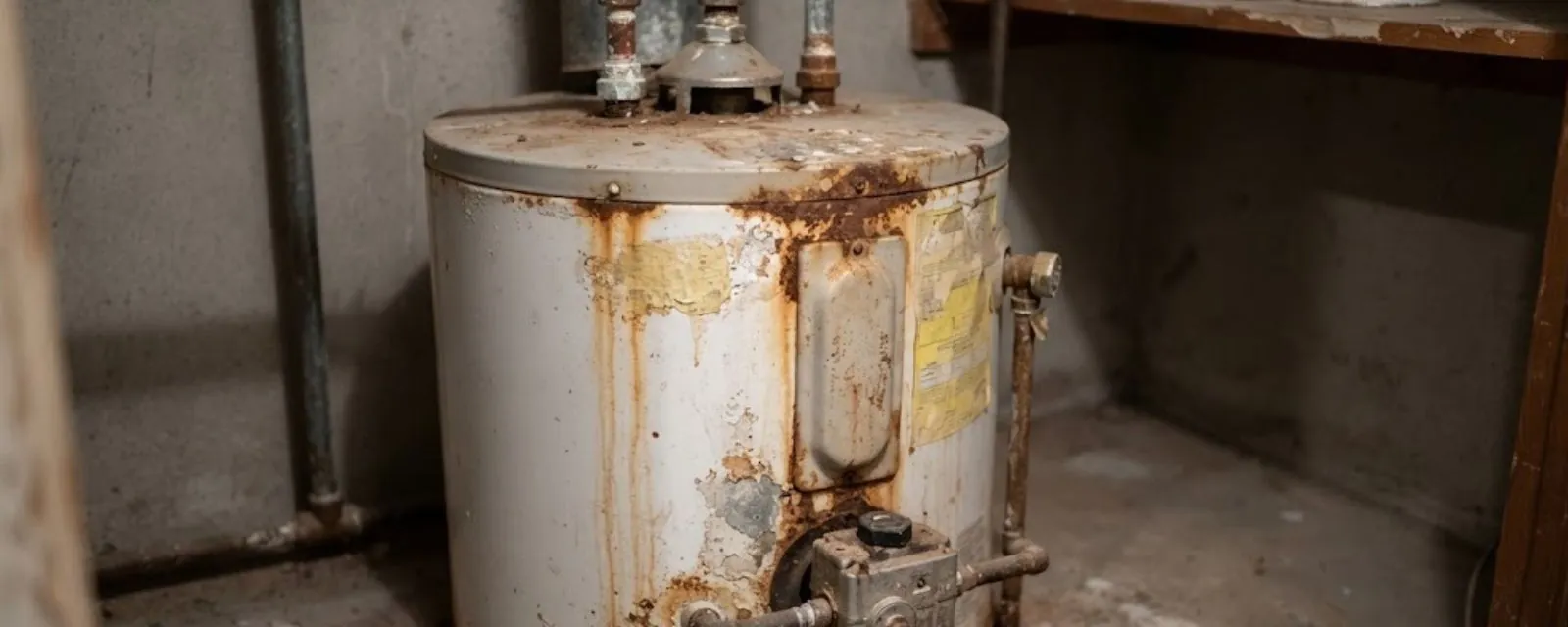
No hot water: a ten-minute triage before the plumber arrives
These checks are safe for most homeowners and give the dispatcher useful information. Stop at any step that feels unsafe.
- Look at the type of heater. A label on the tank says gas, oil or electric. Tell the dispatcher what it says.
- Electric: check the breaker. A tripped breaker is the most common cause of a sudden loss. Reset it once. If it trips again, leave it off and call.
- Gas: look at the pilot or igniter. If the pilot is out, follow the lighting instructions on the tank. If it will not stay lit, a thermocouple or gas valve may have failed.
- Oil: look at the burner switch and the fuel supply. A burner that locked out may have a reset button. Do not press it more than once.
- Check for leaks around the base and the pipes. Any water pooling means the problem has changed from comfort to damage.
If the tank is leaking
The location of the leak matters. Water dripping from the relief valve discharge pipe can mean the tank pressure or temperature is too high, which is a safety item. Water from fittings on top of the tank is often a loose or corroded connection that can be repaired. Water seeping from the bottom or from the tank seam almost always means the tank has rusted through, and the heater has to be replaced.
The discharge pipe from a relief valve has to run to a safe termination under the 2021 International Plumbing Code (IPC) that Connecticut adopts, and a capped or blocked pipe defeats the valve.
Whatever the source, close the cold water supply valve on the top of the tank, turn off the gas or electricity to the heater and protect the floor. Hot water from a failed tank can scald, so keep children and pets away. For a tank that has failed, see water heater replacement.
Where the leak is and what it usually means
This guide helps you describe the leak to the dispatcher.
| Where the water is | Usual cause | Typical outcome |
|---|---|---|
| Top of the tank, at pipe connections | Loose or corroded fitting | Repairable |
| Pipe from the relief valve | Over-pressure, over-temperature or a worn valve | Valve replaced, pressure checked, expansion tank considered |
| Drain valve near the bottom | Worn valve or sediment | Valve replaced or tightened |
| Under the tank, from the jacket | Tank failure | Replacement |
| Condensation on the outside of the tank | Cold water meeting a warm room | No repair, but watch for a persistent trickle |
Gas, oil and electric: three different problems
Gas heaters can fail at the pilot, the thermocouple, the gas valve, the burner or the vent. A gas smell is an emergency that comes before the plumber. Leave the building, call 911 and call Southern Connecticut Gas from outside. The state lists its emergency line as 800-513-8898, and the Guilford Fire Department asks residents with gas or propane leaks to contact 911.
In Connecticut, gas piping and gas appliances follow NFPA 54 for natural gas and NFPA 58 for propane through the state Fire Safety Code, so gas work is not a place for guesswork.
Oil-fired heaters depend on a burner, a nozzle, a fuel supply and a chimney or vent. Electric heaters use upper and lower heating elements and thermostats, and a failed element is a common repair. Gas service in Guilford varies by street, and many homes use oil or propane, per the state's utility notes. If you are unsure what fuel your heater uses, check the label on the tank.
Sediment, scale and noise
A heater that rumbles, pops or heats slowly is often coated with sediment on the bottom of the tank or scale on the elements. Draining and flushing a tank removes some of it.
Hardness changes how fast that happens, and Connecticut Water, which supplies public water in Guilford, says its water quality reports do not give hardness but that customer service can estimate it for your part of the system at 1-800-286-5700. Homes on private wells should test their own water.
An anode rod, a metal rod inside the tank, corrodes in place of the tank walls. When it is used up, the tank itself starts to rust. Replacing a worn rod can extend the life of a heater that is otherwise sound, which is why age and history of the tank matter before any repair decision.
Repair or replace: the plumber's questions
A heater is worth repairing when it is relatively young, the leak is at a fitting or valve and the cost is a fraction of a new unit. It is not worth repairing when the tank itself is failing, when it is near the end of its expected life or when repairs have already stacked up. The plumber asks the age on the data plate and what was done before.
If the heater is working but old, ask about a planned water heater installation before it fails. If you have a tankless unit, the diagnosis is different and our tankless water heater service covers it.
What to do and what not to do around a leaking heater
A leaking or failing heater can scald, flood or release gas. Keep these points in mind.
Do close the cold supply valve above the tank
It stops new water from feeding the leak.
Do turn off the power or the gas control
Breaker for electric, the control knob for gas, the burner switch for oil.
Do not touch the relief valve discharge pipe or the water
Water from a failing tank can be scalding hot.
Do not keep relighting a pilot that will not stay lit
If you smell gas, leave and call 911 and the gas utility from outside.
What affects the price of water heater repair
Repair prices vary with the part and the hour.
- The part.A thermocouple or element costs less than a gas valve or a control board.
- The fuel.Oil burners and gas control valves need different testing equipment.
- Access.A heater in a tight closet or attic takes longer.
- Whether a permit is needed.Replacing a heater can need one. Simple repairs may not, and the plumber says which.
- The hour.Evening, weekend and holiday visits are quoted as emergencies.
Sudden leaks that damage floors or walls are often covered by homeowners insurance, while a worn-out heater itself usually is not. Take photos before cleanup.
No hot water, or a tank leaking now?
Call the 24/7 line and read the label on the heater to the dispatcher. If you are in a flood-prone basement, tell them. If the leak is a pipe rather than a heater, see burst pipe repair.
Questions we hear on calls
Yes. A leaking tank or no hot water in winter is handled as an emergency at any hour, and the line is open 24/7.
The relief valve pipe is where excess pressure or temperature is released. A steady drip can mean the valve is worn or the pressure is too high. A plumber should check both.
It can be. A pilot that will not stay lit may be a failing thermocouple, a draft or a gas valve problem. Do not keep relighting it, and call.
Most tank heaters last about a decade. The data plate gives the manufacture date, and a plumber can tell how much life is left.
Many homeowners do. Turn off the fuel or power, close the cold valve and use a hose to a safe drain. Hot water can scald.
Yes. Tell the dispatcher what fuel the heater uses so the right equipment comes.
Beyond Guilford we send plumbers to Madison, Branford, North Branford and Clinton. Census data show that more than half of occupied homes in Madison and Clinton heat with fuel oil, so oil-fired equipment is common there.
Sources for the local details on this page
The local facts above come from the Connecticut Water quality report page and 2022 Connecticut State Building Code. Rules and figures can change, so check with the town or state office before you rely on them for a permit or a purchase.