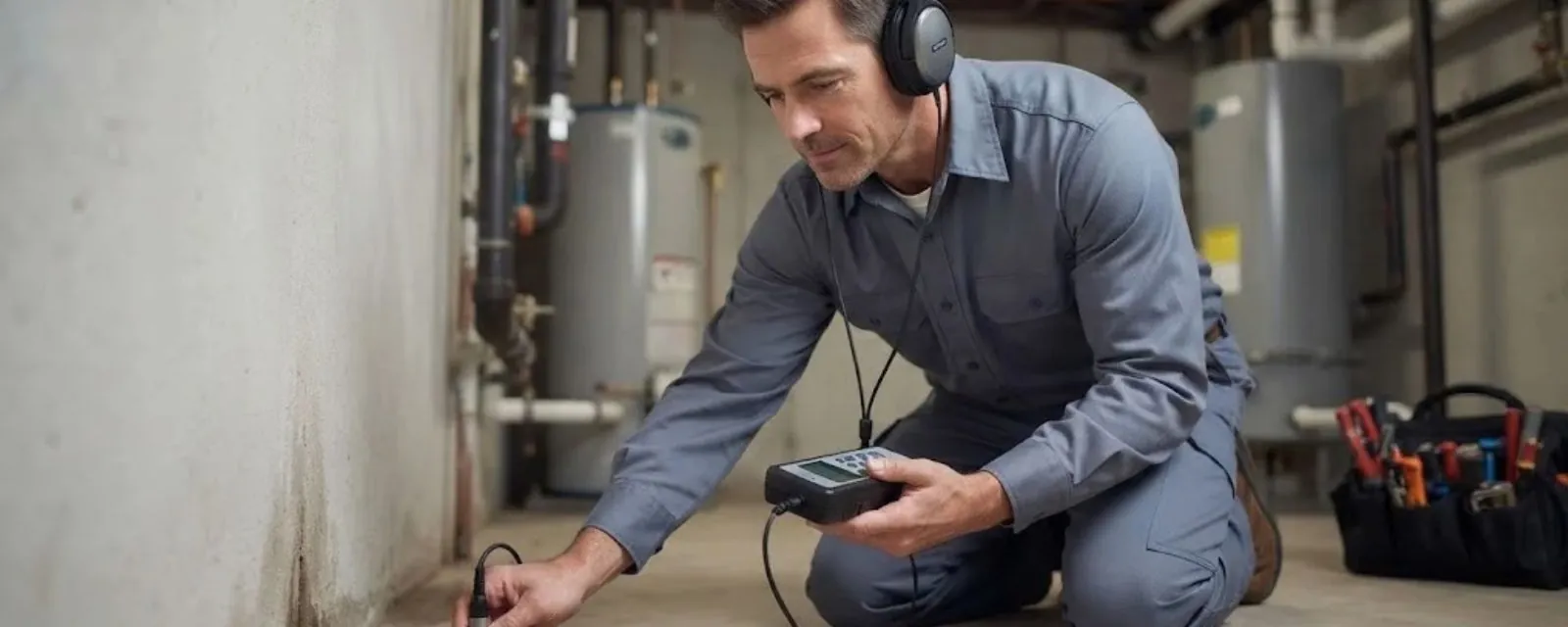
Start with what you see: symptoms that point to a hidden leak
Callers describe leaks long before they name them. These are the signs, in the order we hear them most.
- The meter keeps moving with everything off. Water is leaving the system somewhere between the meter and the fixtures.
- A water bill that jumped without a change in use. A running toilet is the cheapest cause, and a buried line is the most expensive.
- A ceiling stain, a bubbling wall or damp drywall. Water has traveled from its source. The stain is rarely directly under the leak.
- A warm spot on the floor or the sound of running water at night. A hot-water line under a slab or in a floor can heat the surface above it.
- Low pressure at every tap. A major leak before the fixtures can cost pressure.
- A damp lawn or soft ground between the street and the house, or near the well. This points to a buried line.
Meter still running, or the bill jumped
If your water comes from the public system, the meter tells the story. Turn off every fixture and appliance, including the ice maker and the irrigation controller, then look at the meter's leak indicator, a small triangle or dial that spins when any water moves. If it keeps turning, water is leaving the system.
If you shut the main valve at the house and the meter stops, the leak is inside the house. If it keeps turning with the house valve closed, the leak is between the meter and the house, and our water service line page covers that.
Homes on a private well do not have a utility meter, so the test is different. Listen for the well pump cycling when no one is using water, and tell the plumber how often it starts. A pressure tank that cycles every few minutes with all fixtures off points to a leak.
How a plumber finds a leak without opening the wall
Detection uses several tools. Which come out depends on the symptom.
| Method | What it finds | Limits |
|---|---|---|
| Pressure test | Whether a line holds pressure | Shows a leak exists, not where |
| Acoustic listening | The sound of water escaping from a pressurized pipe | Quiet or plastic pipe can be hard to hear |
| Thermal imaging | Temperature differences from hot-water leaks or wet insulation | Surface only, needs a temperature contrast |
| Moisture meter | Dampness in drywall, wood and floors | Shows the wet area, not always the source |
| Tracer gas | Escaping gas from a pressurized line | Needs gas equipment, used when other methods fail |
| Camera | Condition of drain lines | Drains only, not supply lines |
A plumber may use more than one method on a job, because the best answer is often the overlap of two.
Ceiling, wall and attic leaks
Water finds the easiest path. A stain on a first-floor ceiling can come from a bathroom drain, a supply pipe, a window or a roof leak above. The plumber works backward from the stain, checking the fixtures above it and running water through them one at a time.
If a stain appears only when someone showers, the leak is in the shower drain or its trap. If it appears when the heat comes on, it may be a baseboard heating pipe. If it appears after rain, a roof or window is the likelier source. A leak that is not plumbing is something we say plainly, so you can call the right trade.
Under the house, in the crawlspace and under a slab
A leak under a floor can run for weeks before it shows. In a crawlspace, the signs are damp insulation, mold smell, a moisture pattern on the ground and rusting fittings. Where a house sits on a concrete slab, supply lines under the slab can leak and heat the floor above them, which is why a warm spot is a recognized symptom of a slab leak.
Slab leaks are a diagnosis problem first. Locating one needs a pressure test and listening equipment, then a decision between breaking the slab, rerouting the line through the walls or replacing the section. We do not know in advance whether your house has a slab, a crawlspace or a basement, so say what you have when you call.
Buried lines, yards and irrigation
The line from the meter or well to the house is buried, and it can leak for a long time before the surface shows it. A wet patch in a dry week, a soft lawn strip or a spot that stays green is a sign. Irrigation systems leak at valves and heads, and a stuck valve can run all night. Shut the irrigation controller off during a leak search so it does not hide the answer.
The Connecticut Water report for Guilford says some older homes may have service lines made of lead or unknown materials and offers a lookup at ctwater.com/serviceline. If your line is old and leaking, read about repair and replacement on the service line page.
Pools, spas and fountains
A pool or spa that loses more than evaporation explains may have a leak in the shell, the plumbing or the equipment. A plumber can pressure-test the lines to the equipment. Shell leaks and liner problems belong to a pool contractor, and we say so when that is what the test shows.
What the code says when a leak is found
Under the 2022 Connecticut State Building Code, which adopts the 2021 International Plumbing Code (IPC), stopping leaks and clearing stoppages is exempt from a permit as long as the repair does not involve replacing or rearranging valves, pipes or fixtures. Replacing concealed pipe that has become defective is treated as new work and needs a permit.
For a hidden leak, that means finding it is not a permit matter, but opening a wall to replace the pipe may be. The plumber tells you which side of that line your repair falls on.
What to do while you wait for the plumber
Hidden leaks do their damage quietly. These steps limit it and keep you safe.
Close the main if water is visibly moving
Turn the main valve clockwise. If it will not turn, tell the dispatcher.
Stay out from under a bulging ceiling
A ceiling holding water can fail without warning. Keep people and pets away and call.
Keep power away from water
Do not touch outlets, switches or appliances near wet areas, and switch a breaker off only from dry ground.
Photograph stains and the meter
Dated photos of the stain and the meter reading help the plumber and your insurer.
What affects the price of leak detection
Detection is priced by time and method.
- The size of the property.A small house is faster to cover than a large one with several floors.
- The methods needed.Listening and pressure tests are quick. Thermal and gas tracing add equipment.
- Access.Open basements are fast. Finished rooms and occupied floors take longer.
- Repair afterward.Opening a wall and closing it again is separate from the detection.
- The hour.After-hours visits are quoted as emergencies.
Insurance policies differ on the cost of finding a leak. Some pay for the access and repair of a covered loss. Ask your insurer before work starts, and keep records and photographs.
Water going somewhere it should not?
Call the 24/7 line. Say what you see, whether the meter is moving and whether you have city water or a well. If a pipe has already burst, see burst pipe repair.
Questions we hear on calls
Yes. A leak that is damaging the house is handled as an emergency at any hour. The line is open 24/7 and a plumber is dispatched as soon as an appointment opens up.
Turn off all water use, then watch the meter's leak indicator. If it moves, water is escaping. Close the main valve at the house and see whether it stops.
Often. Acoustic, thermal and moisture tools narrow the location so the opening is small.
A hot-water line near the surface may be leaking. It is worth a prompt call.
Usually not. The utility's responsibility ends at the meter, and the pipe from there to your house is yours.
Yes. A stuck valve or broken head can run for hours unnoticed.
Yes, in Madison, Branford, North Branford and Clinton. Say whether you have a water meter or a private well, because the first test is different.
Sources for the local details on this page
The local facts above come from the Connecticut Water 2025 Guilford System report and 2022 Connecticut State Building Code. Rules and figures can change, so check with the town or state office before you rely on them for a permit or a purchase.