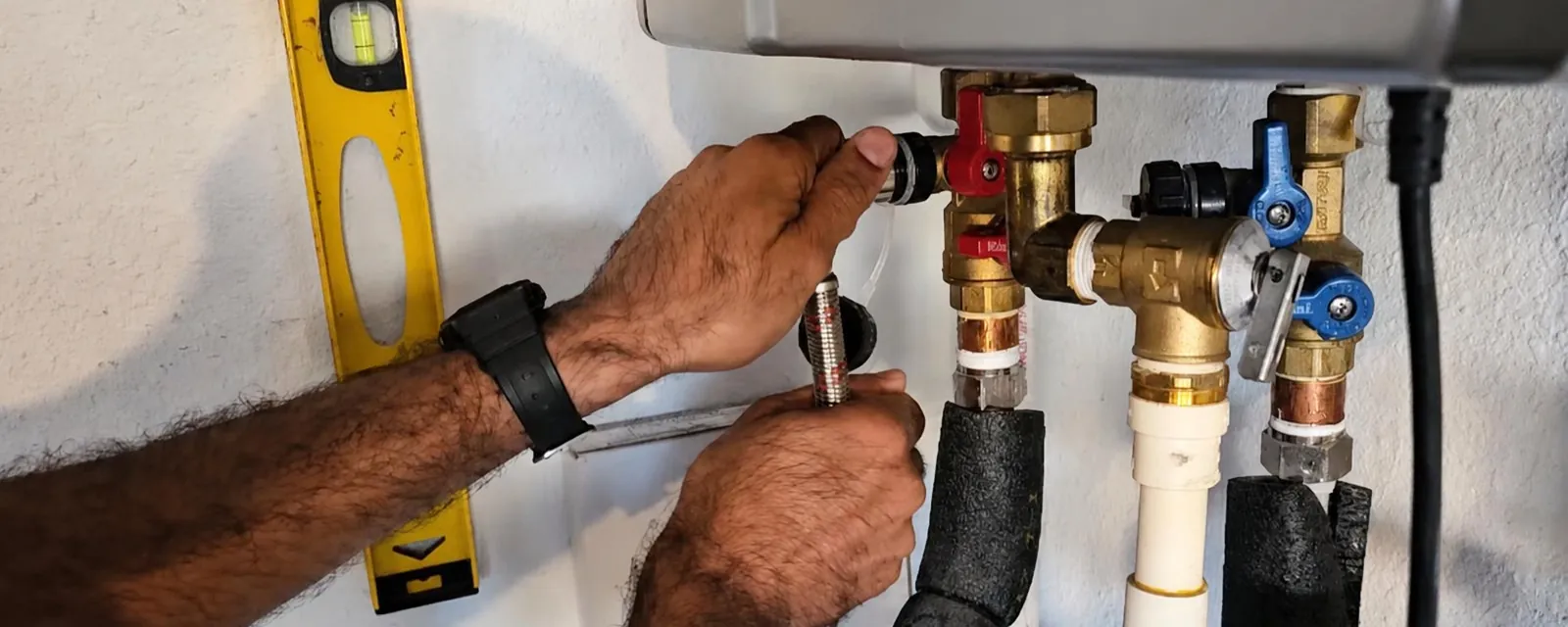
How a tankless unit differs from a tank heater
A tank heater keeps 40 to 80 gallons hot all day. A tankless unit fires a burner or electric elements the moment flow is detected and heats water as it passes through a heat exchanger. Flow rate, measured in gallons per minute, and the temperature rise from your incoming water decide whether one unit can run two showers and a dishwasher at once.
Incoming water on the Connecticut shoreline is coldest in winter, so a unit sized only for summer temperatures can disappoint in January.
When we quote a tankless installation we size it against the coldest water you will see and the most fixtures that run together.
The trade-off is infrastructure. A gas unit may need a larger gas line and its own vent. An electric unit can need heavy-gauge wiring and enough spare capacity in the electrical panel. A condensing gas model produces acidic condensate that must drain somewhere, often through a neutralizer.
Common tankless problems and what they usually mean
Error codes differ by manufacturer, so the manual or the label on the unit is the final word. These patterns show up on calls in every brand.
| What you notice | Usual cause | Typical fix |
|---|---|---|
| Water goes cold, then hot, then cold | Flow too low to keep the unit firing, or a clogged cold-water inlet filter | Clean the inlet filter, check the flow, flush the unit |
| Unit shuts off after a few minutes | Scale on the heat exchanger or a venting restriction | Descaling flush, vent inspection |
| Error code with no hot water | Ignition, flame sensor, vent or gas supply problem | Diagnosis by code, cleaning or part replacement |
| Rumbling or popping noise | Scale boiling under the heat exchanger deposits | Descaling flush |
| Less hot water than before | Partly scaled heat exchanger or a valve problem | Flush, test flow and temperature rise |
Why flushing matters, and what a flush involves
Minerals in water come out of solution when heated and stick to the inside of the heat exchanger. Left alone, they insulate the metal, force the unit to work harder and cause overheating shutdowns. The signs that a flush is due are in the table above. The flush itself is a routine service.
- Power and gas are shut off. The unit is isolated, and the cold and hot service valves are closed.
- Hoses and a pump connect. A small pump circulates a descaling solution through the unit in a closed loop. Many homeowners try plain household vinegar, but manufacturers publish their own flushing procedures, and following the one in your manual protects the warranty.
- The solution circulates for the time the manufacturer specifies. Then the system is rinsed with clean water.
- The inlet filter is cleaned. A clogged filter is one of the simplest causes of low flow.
- The unit is restarted and tested. We confirm flow, temperature and that no error code returns.
What scale means for a home on well water or public water
Hardness varies across the Guilford area depending on whether a home is on public water or a private well. We do not state a hardness figure for any address. Connecticut Water, which supplies public water in Guilford, says its annual water quality reports do not include hardness, and that its customer service can give an estimate for your area of the system.
The practical advice is the same either way: if you see white crust on faucets or kettles, schedule flushes more often and ask about a softener or scale reducer for the tankless unit.
When replacing the unit is smarter than repairing it
Tankless units are designed to last longer than tank heaters, but they are not maintenance-free. If a unit has never been flushed, has a cracked heat exchanger or has a circuit board failure beyond the warranty, repair cost can approach replacement cost.
We also look at the unit that is already there, and if it has failed in the dead of winter our emergency replacement service applies. A first-generation unit with parts that are hard to source is a poor candidate for another repair. If you are switching from a tank heater to tankless, or the reverse, the same questions about fuel, venting and gas capacity apply, and our water heater installation page covers the tank side.
For tankless units that have stopped heating altogether during a cold snap, the call is more urgent. Our water heater repair service covers emergency no-hot-water situations on both tank and tankless.
What decides the price of tankless work
Tankless work spans a quick flush to a full replacement with new venting. These items decide where yours lands, and the price is clear before work starts.
- Flush or repair or replace.A flush is the smallest job. A control board or heat exchanger repair is larger. Full replacement depends on the model chosen.
- Fuel type.Gas, propane and electric units have different installation requirements.
- Venting.New vent routes through walls or the roof add materials and labor.
- Gas line or electrical capacity.Upsizing a gas line or adding an electrical circuit can be a separate part of the quote.
- Condensate and water treatment.A neutralizer or a scale reducer adds parts but protects the unit.
Warranty terms vary by manufacturer and often depend on installation by a licensed plumber and on documented maintenance. Keep your flush records. Want your real number? Call the 24/7 line.
Permits and who may do the work
Installing or replacing a water heater that burns gas or oil is regulated work in Connecticut. Permit rules vary, so ask the Guilford building department about what your project needs. A licensed plumber handles the permit as part of the job. The state adopts the 2021 International Plumbing Code (IPC), and gas units follow NFPA 54 for natural gas and NFPA 58 for propane, so venting and gas supply are built to those standards.
Tankless water heater not heating?
If you have no hot water at all, call the 24/7 line and describe any error code on the display. If you are planning a new installation, call during the day and we will schedule an appointment with a plumber who can see the gas, vent and electrical situation.
Questions we hear on calls
The manufacturer's manual gives the interval, and it depends on your water. Homes with visible scale on faucets generally need more frequent flushes than homes with soft water.
Usually. Many codes point to a vent, flame sensor, gas supply or flow issue. Give the dispatcher the brand, model and code.
It depends on how many fixtures run together, your fuel and the cost to upgrade gas, venting or wiring. We walk through those before you commit.
Yes. Tell us the brand and age. We may also check the inlet filter and the venting as part of the visit.
Some homeowners do, but manufacturers have specific procedures and some void warranties on improvised methods. Check your manual first.
Yes. The 24/7 line is open when a no-hot-water call comes in on a cold night, and a plumber is sent as soon as an appointment opens up.
Sources for the local details on this page
The local facts above come from the Connecticut Water quality report page and Guilford Building Department permit page. Rules and figures can change, so check with the town or state office before you rely on them for a permit or a purchase.