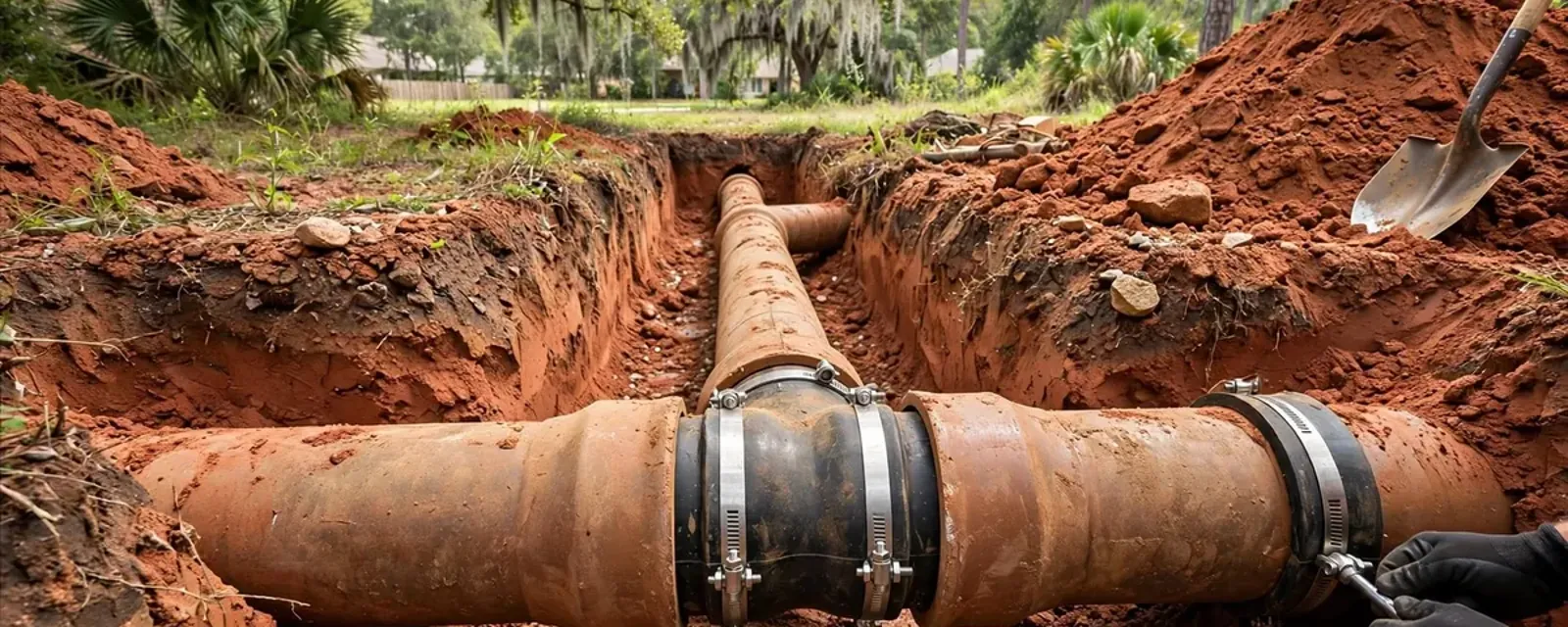
How a sewer line fails
Roots
Roots follow moisture and enter a pipe through any gap. Once inside, they thicken and catch waste. Cutting them restores flow, but unless the opening is repaired they return.
Cracks, offsets and bellies
Ground movement, freeze and thaw cycles, heavy loads and old joints can crack a pipe or shift sections out of line. A section that sags holds water and waste and creates a repeating clog.
Material failure
Cast iron rusts through from inside. Clay pipe has many joints, and each one is a path for roots. Orangeburg, a fiber pipe used in some mid-century homes, deforms with age. Every material has its own way of failing.
Repair options, compared
The right method depends on what the camera shows. This table is a starting point for the conversation with the plumber.
| Method | What it is | Best when |
|---|---|---|
| Spot repair | Dig down and replace a short damaged section | One isolated crack or offset, accessible location |
| Pipe lining (cured-in-place) | A resin-soaked liner is inflated inside the old pipe and hardens into a new pipe within the pipe | Cracks or root entry along a pipe that is otherwise in shape and aligned |
| Pipe bursting | A new pipe is pulled through as the old one is broken apart | Whole-run replacement when digging is limited |
| Full replacement by trench | Dig the full run and install new pipe | Collapsed or badly misaligned lines, or when the grade must be corrected |
Lining and bursting are often called trenchless, but they still need entry points. Neither can correct a pipe that has lost its slope.
Questions the plumber will ask on the call
Having the answers ready speeds up the diagnosis.
- When did it start, and what did you notice first? Slow drains, gurgles and backups point to different sections.
- How old is the house, and what is the pipe made of? Cast iron, clay, PVC and fiber pipe fail differently.
- Where does the line go? Under the house, across the yard, under a driveway or toward the street.
- Have there been previous repairs or clog histories? A repeating clog in the same spot is a clue.
- Where does the line end? In Guilford the line runs to a septic tank, and the tank location matters for any dig.
Camera first, then the plan
The only way to know whether the problem is a cleaning job or a repair job is to look. Our sewer camera inspection sends a camera through the line and records the pipe condition, the location of any damage and its depth. With that, a plumber can show you the problem and explain the options, and a locator at the surface marks where the dig would go.
A repair without a camera is a guess, and a guess under a driveway or a patio is expensive. If you have had a camera inspection from another company, send the video to the plumber.
Guilford has no municipal sewer, so the line runs to your tank
In Guilford the "sewer line" is the pipe from your house to a septic tank. The town's plan says Guilford does not have sewers, and the health department says disposal is on-site. That makes the location of the tank part of every repair plan, because a dig must stay clear of the tank and the leach field.
The town's Building Department takes permit applications online and asks for a valid state license and liability insurance. The state code treats stopping leaks and clearing stoppages as work that does not need a permit, but replacing concealed drain pipe is new work and does. Septic tank or field repairs need a separate health department permit.
The 2022 code materials add that the International Private Sewage Disposal Code is not adopted and that septic systems follow state regulations under Connecticut General Statutes section 19a-36. The building drain itself follows the 2021 International Plumbing Code (IPC) that the state adopts.
What to do and what not to do if sewage is backing up
Sewage carries bacteria. Treat any backup as a health matter as well as a plumbing matter.
Stop all water use
No flushing, laundry, dishwasher or showers until the plumber says so.
Keep children and pets out
Keep them away from the wet area until it has been cleaned and disinfected.
Do not use drain chemicals
They will not clear a main line problem and they make a cable job more hazardous.
Wear gloves and wash up
If you must touch anything wet, wear waterproof gloves and wash hands well afterward.
What changes the price of a sewer repair
Sewer repair prices vary more than almost any plumbing work.
- Depth and length.A short, shallow repair is a small job. A deep or long run is a major excavation.
- What is on top.Lawn costs less to restore than a driveway, a patio or a deck.
- Method.Spot repair, lining, bursting and trench replacement differ in cost and time.
- Pipe condition beyond the damage.If more of the line is failing, a longer repair may be better value.
- Permits and inspection.Permit rules vary, so ask the building department what applies.
A sudden sewer backup may be covered under a water backup endorsement, but the repair of the pipe itself generally is not. Check your own policy.
Sewer line failing or backing up?
Call the 24/7 line. If sewage is rising, stop using water. If the line is simply slow, start with sewer line cleaning and a camera look.
Questions we hear on calls
Yes. A sewer backup that damages the house is an emergency, and the line is open 24/7. Planned digs are scheduled during normal hours.
Sometimes. Pipe lining and bursting reduce digging, but they need access points, and they cannot fix a pipe that has lost its slope.
A camera shows them. A history of clogs that return in months is a common sign.
In Guilford, yes. There is no municipal sewer main, so the line and the septic system on your property are yours.
A spot repair can finish in a day. Longer runs, lining and replacements take longer. The plumber gives an estimate after the camera.
Replacing concealed drain pipe is new work under the state code and needs a permit, while clearing a stoppage does not. Septic tank or field repairs need a separate health department permit.
Yes. Branford has a municipal sewer serving most residences, so a repair there may involve the town main, while Madison, North Branford and Clinton rely more on septic lines like Guilford.
Sources for the local details on this page
The local facts above come from the 2022 Connecticut State Building Code, Guilford Building Department permit page and Guilford Health Department environmental health page. Rules and figures can change, so check with the town or state office before you rely on them for a permit or a purchase.