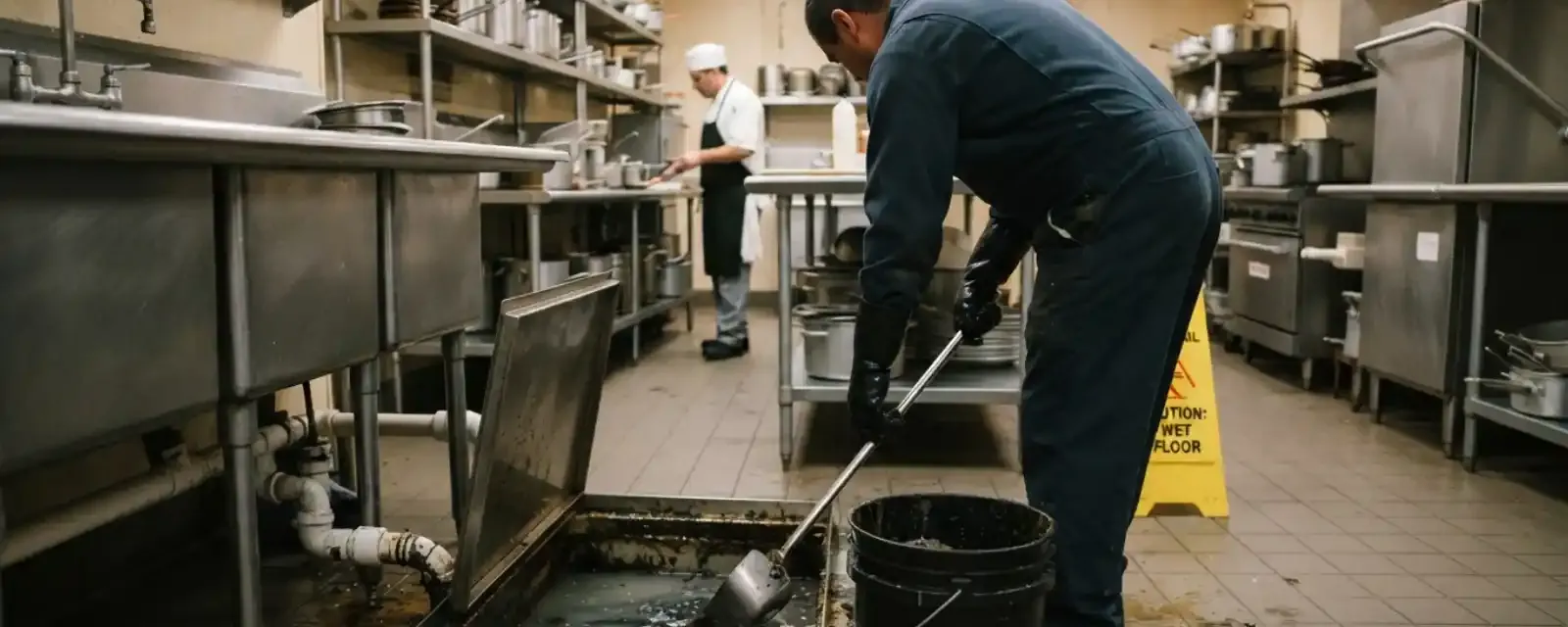
When a commercial plumbing problem is an emergency
For a business, an emergency is anything that closes the doors, threatens the stock or creates a health issue. Floor drains that back up in a kitchen, toilets that stop working for customers and water coming through a ceiling onto equipment all qualify. A slow drip in a back room does not, but it should be scheduled before it gets worse.
Tell the dispatcher what the business does, how many restrooms and floors are affected and whether the building is owned or leased. If you rent, your landlord may need to be told, and some leases require the landlord's contractor. We can still make the situation safe.
Common commercial calls
Commercial properties see a pattern of calls that differs from homes. This guide shows the typical problem and how we approach it.
| Business type | Typical problem | What we focus on |
|---|---|---|
| Restaurant or cafe | Grease-laden drains, floor drains backing up | Jetting, grease trap service, drain inspection |
| Retail shop or office | Restroom stoppages, water heater failure | Quick restoration of fixtures, heater replacement |
| Multi-unit building | Leaks between units, shared drain clogs | Locating the source, serving tenants fairly |
| Marina or waterfront building | Drain and supply issues in exposed structures | Corrosion-resistant fittings, drain checks |
| Industrial or storage | Floor drain and storm drain problems | Drain cleaning, camera inspection |
Drains, grease and the camera
Commercial kitchens send grease, starch and food waste into drains that were not designed for it alone. A grease trap or interceptor catches fats before they reach the building drain, but only if it is cleaned on schedule. A full trap is a common reason a restaurant drain backs up.
When a drain keeps clogging, we run a camera through the line to see the cause. It might be grease, roots, a belly in the pipe or a collapsed section. High-pressure water, called hydro jetting, clears stubborn grease buildup, and a sewer camera inspection shows what the line looks like afterward.
Backflow testing, grease traps and storm drains
Backflow preventers protect the public water supply from contamination if pressure drops. Many commercial buildings have them on irrigation, fire lines and some process equipment. Who must test them, how often and who may perform the test are set by the water provider and state rules, so ask your provider for the current requirement. We can coordinate testing and repair as part of a visit.
Grease trap cleaning is a service of its own in many places, and haulers are often licensed to dispose of the waste. We help diagnose a failed trap and arrange appropriate service. Storm drains and catch basins around parking areas fill with silt and leaves. A clogged storm drain is a drainage and flooding issue, not a sewer problem, and we explain the difference when we visit.
Leak detection in occupied buildings
Commercial leaks can run for a long time before anyone notices, hidden in ceilings and under slabs. The first clue is often a water bill that jumped.
A plumber can check the meter with all fixtures off, then isolate sections of the building to find where the loss is. Commercial leak detection has a lower rate of booked work in our call data than other services, so we are straightforward: we find the leak, tell you what it costs to fix and let you decide.
What to do while you wait: staff and customer safety
In a shop or restaurant, safety for customers and staff comes before the repair.
Close off wet floors
Use cones or signs so customers and staff do not slip.
Shut the main for the building
Find the valve before the plumber arrives and tell the dispatcher where it is.
Keep food and equipment away from sewage
Do not prepare food in an area where a drain has backed up.
Tell the landlord or property manager
If you rent, they may need to know, and they may hold the keys to a utility room.
What affects commercial plumbing prices
Commercial quotes follow the building and the hour. These are the main drivers, and the price is clear before work starts.
- Scope and building size.A single restroom is not the same as a three-story building.
- After-hours work.Calls outside business hours are quoted as emergencies.
- Access and safety.Work in kitchens, roofs and mechanical rooms needs coordination with the operator.
- Permits and inspection.Commercial work may need plumbing and mechanical permits, and the town asks for a state license and insurance with each application.
- Parts and equipment.Commercial heaters, valves and pumps cost more than residential equivalents.
Business property policies differ widely. Ask your insurer how it handles water damage and business interruption, and document everything.
Commercial plumbing emergency?
Call the 24/7 line, tell the dispatcher what the business is, and say which fixtures are affected. For repeat problems, ask about a camera inspection so the real cause is found.
Questions we hear on calls
Yes. The line is open 24/7. A burst pipe, a drain backup or a failed heater in a commercial space is treated as an emergency at any hour.
We diagnose and service grease-trap related plumbing and can arrange pumping with a hauler. Ask the dispatcher what your system needs.
We coordinate testing and repairs. Requirements for testers and frequency come from your water provider and state rules, so ask them what applies.
It depends on the lease. In an emergency, shutting off the water and calling us stops the damage. Then tell your landlord.
Yes. Planned work can be scheduled early, late or on a closed day to limit disruption.
Yes. Camera inspection is a standard part of finding why a commercial drain keeps clogging.
Yes. Shops and restaurants in Branford, Madison, North Branford and Clinton reach the same 24/7 line.
Sources for the local details on this page
The local facts above come from the Guilford Building Department permit page and state's plumbing license classes. Rules and figures can change, so check with the town or state office before you rely on them for a permit or a purchase.