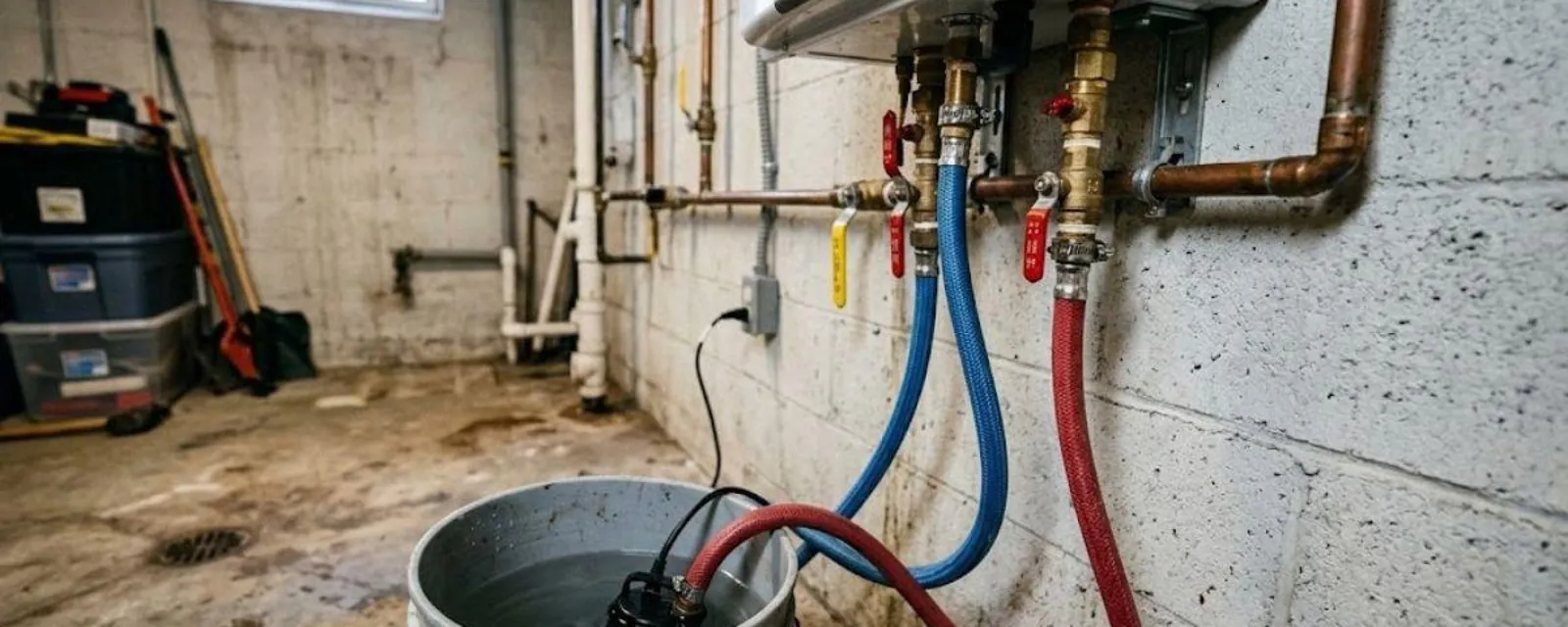
Why scale builds up in a tankless unit
Hard water carries dissolved calcium and magnesium. When the water is heated, those minerals precipitate out and stick to hot surfaces. In a tankless unit, the heat exchanger is a narrow passage heated to a high temperature, which makes it a prime place for scale. A thin layer insulates the metal and forces the unit to work harder. A thick layer restricts flow, triggers error codes and shortens the life of the unit.
The result is a heater that rumbles or pops, delivers less hot water than before or shuts down. A flush dissolves the scale and carries it out of the unit.
What you need for a vinegar flush
Gather the materials before you shut anything off.
- A small submersible pump. A utility pump with hoses that connect to the service valves.
- Two hoses with the right fittings. Most tankless units have service valves with hose-ready ports.
- About three to four gallons of white vinegar. Undiluted white vinegar is a common choice, but the manual may specify otherwise.
- A five-gallon bucket. The solution circulates from the bucket through the unit and back.
- Clean water and a safe drain. You rinse with fresh water and need a laundry tub, floor drain or outdoors to empty the bucket.
Guilford note: how hard is your water, and where does the flush water go?
Connecticut Water supplies public water in Guilford through its Guilford System and says its annual reports do not include hardness but that customer service can give an estimate for your part of the system at 1-800-286-5700. The company's report shows sodium in a range of 7.9 to 81.6 parts per million and chloride up to 89.1 parts per million, which are separate measurements and not hardness, so do not use them as a stand-in.
Some Guilford shoreline communities used individual wells when the town studied them in 2011. If your house has a private well, test the water for hardness and iron through a lab, since both leave deposits. Because Guilford has no municipal sewer, every drain in the house feeds a septic tank, and the town's guidance says not to backwash water treatment equipment into the septic system.
A flush sends a large volume at once, so empty the bucket slowly over time and ask your pumper whether it is a concern for your tank.
The flush, step by step
Turn off power and the gas supply, then close the isolation valves on the hot and cold lines. Connect one hose to the cold service port and one to the hot service port, and run both into the bucket with the pump. Open the service valves to the hose side and run the pump so the vinegar circulates through the unit.
Circulate for the time your manual lists, often 45 minutes to an hour. Turn the pump off, empty the bucket, flush with clean water, and clean the inlet water filter. Close the service ports, open the isolation valves, restore gas and power, and test with a hot tap. Rinse any scale off the filter screen before it goes back.
Vinegar, descaling solution and doing nothing
Each choice has a place. This table compares them.
| Option | Strength | Limits |
|---|---|---|
| White vinegar | Common, inexpensive, widely used | Weaker than some purpose-made solutions, check the manual |
| Manufacturer descaling solution | Matches the maker's procedure and warranty | Costs more, must be bought for your brand |
| Professional flush | Done with the right pump and checks | Costs a service visit |
| Scale reducer or softener | Prevents buildup | Needs maintenance, and softener discharge should avoid the septic system |
| Doing nothing | No effort | Scale builds, flow drops, errors and shutdowns follow |
Mistakes that cause repairs
These errors turn a routine flush into a service call.
- Leaving the gas or power on. The unit can fire with no water moving.
- Using the wrong hoses or loose clamps. Vinegar sprays and can ruin finishes.
- Skipping the inlet filter. A clogged filter is a common cause of low flow and it is easy to clean.
- Forgetting to rinse. Leftover acid can irritate the first draw of hot water.
- Not closing the service valves properly afterward. The unit does not get water and shuts down with a code.
After the flush: how to know it worked, and when to call
A good flush shows in the water. Hot water should arrive steadily without the cold-hot-cold pattern, the unit should be quieter, and the temperature rise should match what it did when it was new. The vinegar in the bucket will often look cloudy with white flakes, which is the scale you removed.
If error codes return, flow stays weak or the unit rumbles again within weeks, the problem may be more than scale. A failed sensor, a cracked heat exchanger or a venting issue can look the same. At that point, see our water heater repair page and call a plumber instead of flushing again.
Protecting a tankless unit between flushes
Clean the inlet filter screen every few months, since a clogged screen cuts flow and triggers shutdowns. Keep the temperature setting reasonable, because scale forms faster at higher temperatures. If your water is hard enough to leave white crust on faucets, a scale-reduction cartridge on the cold line slows the buildup.
Write the date of each flush on the unit or in a notebook. A record helps you decide the next interval, and it supports a warranty claim if the manufacturer asks for proof of maintenance.
Questions we hear on calls
In the recommended dilution and time, it is commonly used. Some manufacturers specify their own solution, so check the manual.
Follow the manual. Homes with visible white crust on faucets usually need flushes more often.
Not if done as the manufacturer describes. Improvised methods may not be covered.
Every drain in a Guilford house feeds a septic tank, and the town's septic guidance advises against backwashing water treatment equipment into a septic system. Empty the bucket slowly in small amounts, and ask your pumper if you are concerned.
Yes. See tankless water heater service for what a flush visit involves.
Yes. See Branford and North Branford.
Sources for the local details on this page
The local facts above come from the Connecticut Water quality report page and town's septic system brochure. Rules and figures can change, so check with the town or state office before you rely on them for a permit or a purchase.