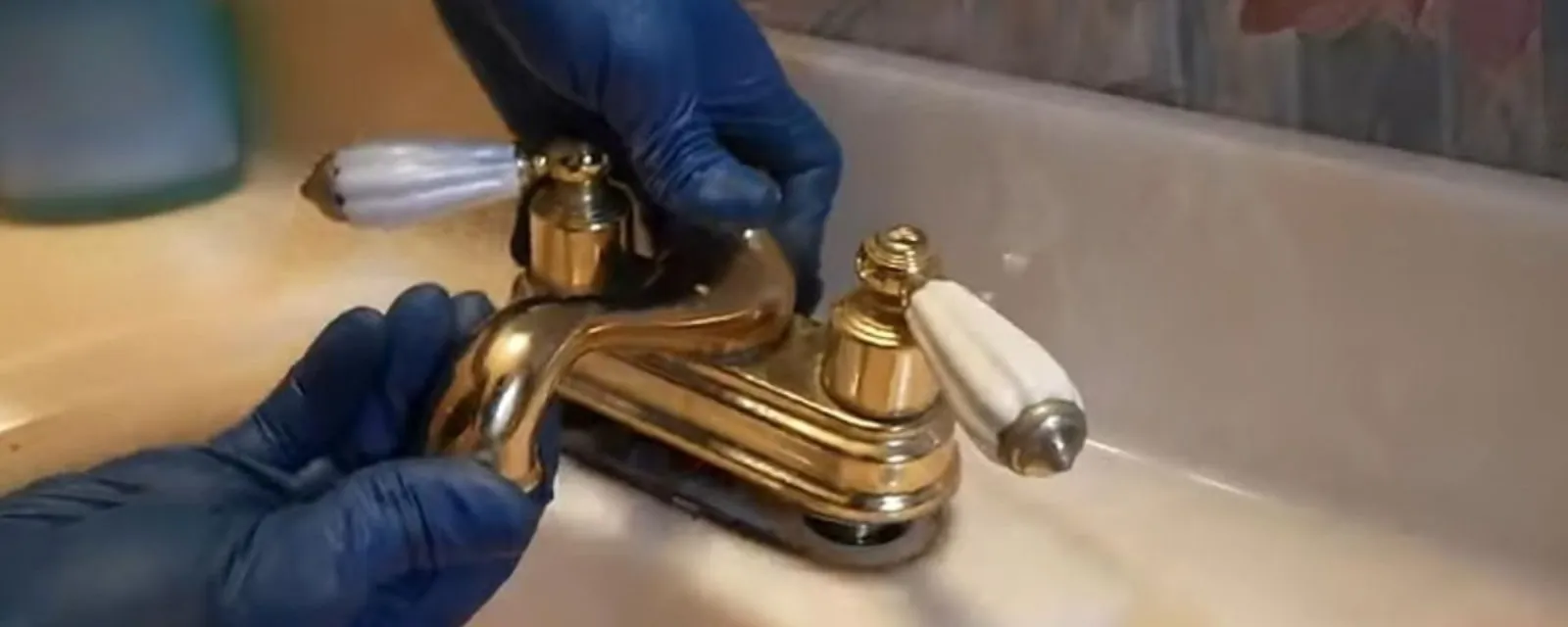
Four faucet designs and where each one leaks
Look at your faucet. How many handles it has and how they move tell you the design.
| Design | How to recognize it | Usual leak | Part to replace |
|---|---|---|---|
| Compression | Two handles that screw down | Drips from the spout when closed | Rubber washer and seat |
| Cartridge | Single or double handle that lifts or turns smoothly | Drips from the spout or leaks at the handle | Cartridge and O-rings |
| Ball | Single handle over a rounded cap | Leaks at the base of the handle | Seals and springs, ball if worn |
| Ceramic disc | Single handle, quarter-turn feel | Drips from the spout | Disc cartridge |
Step one: stop the water, then find the leak
Close the two shutoff valves under the sink, hot and cold, then open the faucet to drain it. Plug the sink drain so a dropped screw does not vanish. Take a photograph at every step of disassembly. Photos make reassembly easy and show the part you need to match.
A drip from the spout means the part that closes the water path is worn. A leak around the handle means the packing or O-ring has failed. Water pooling under the sink may be a supply line or the base gasket and not the faucet at all. Dry everything and watch for the first drop.
Guilford note: public water, wells and what a leak repair needs
Public water in Guilford comes from Connecticut Water's Guilford System, which draws on surface reservoirs and groundwater wells. The company says its annual water quality reports do not include hardness, but that customer service can give an estimate for your part of the system at 1-800-286-5700. If your faucet aerator clogs with white flakes, that is the number to ask for.
Some Guilford shoreline neighborhoods were on individual wells when the town studied them in 2011, and well water can carry sediment and minerals that wear faucet parts faster. If you are on a well, a sediment filter before the faucet can cut down on repairs. On permits, simple faucet repairs fall under the leak-repair exemption in the state code.
When repair is not worth it
A replacement faucet is often the better choice in these cases.
- The faucet body is corroded or pitted. New parts will not seal against a damaged seat.
- The finish is flaking or the spout wobbles. The faucet is at the end of its life.
- The parts are no longer made. Discontinued models can cost more to repair than to replace.
- The leak keeps coming back. A seat that is rough will chew through new washers.
- You are remodeling. A new faucet costs little compared with the sink and counter.
Supply lines and shutoff valves: the hidden leakers
Many leaks blamed on faucets are actually from the braided supply lines or the small stop valves under the sink. If a valve drips at the stem or will not turn, replace it before it fails during the repair. Old braided lines with corroded fittings can burst without warning. For handling those, our faucet and valve repair page explains the repair side.
A faucet that has been leaking for a long time can leave a stained, swollen cabinet floor. Check for soft particleboard, which swells when wet, and replace it if it crumbles.
A cartridge swap, step by step
This is the most common faucet repair. It takes about half an hour once the water is off and you have the right cartridge.
- Shut off the water and open the faucet. Close both stops under the sink, then open the faucet to let the pressure out.
- Remove the handle. Pry off the cap, undo the set screw and lift the handle away.
- Unscrew the retaining nut or clip. Photograph how it sits before you remove it.
- Pull the cartridge straight up. Twist it gently if it sticks. Note which way the stem faces.
- Match the new cartridge to the old one. Bring the old cartridge to the store, since small differences matter.
- Reassemble in reverse and test. Turn the water on slowly and check for leaks at the handle and spout.
Low flow and sputtering are not always the cartridge
A faucet that sputters or runs weakly often has a clogged aerator, the small screen at the tip of the spout. Unscrew it, soak it in vinegar and rinse out the flakes. If the whole house is weak, the cause is upstream, such as a partly closed valve, a failing pressure regulator or a leak, and our water service line page explains where to look.
If hot water is weak but cold is fine, the problem may be the heater or its valve, not the faucet. A mixing valve that no longer balances temperature can also make the shower scalding or cold in turns, which is a safety issue and a reason to call.
When to stop and call a plumber
Call if the shutoff valves under the sink will not close, if the faucet is a wall-mounted or tub-and-shower model with parts behind the wall, or if you see water stains on the ceiling below. Call if the faucet body is corroded or the leak is at the base and you cannot reach the connections.
A plumber also brings the right part the first time. Faucet parts are specific to the brand and model, so a photo of the faucet and any name stamped on it helps. If the leak is part of a bigger problem, such as several fixtures dripping because of high pressure, say so on the call.
Questions we hear on calls
The valve seat may be pitted, so a new washer cannot seal. The seat can be dressed with a tool, or the faucet replaced.
A faucet that drips steadily can waste thousands of gallons a year. If you are on a meter, you pay for every drop.
Mineral buildup can clog aerators and cause cartridges to stick or wear. Connecticut Water says it can estimate hardness for your part of its system on request.
The 2022 Connecticut State Building Code exempts repairing leaks in pipes, valves or fixtures, as long as the repair does not involve replacing or rearranging valves, pipes or fixtures. A faucet cartridge is a simple repair.
Many homeowners do. You need the right wrench for the nuts under the sink and new supply lines. Call if the shutoff valves will not close.
For a faucet that will not shut off, yes. See Clinton and North Branford pages for towns we also serve.
Sources for the local details on this page
The local facts above come from the Connecticut Water quality report page and 2022 Connecticut State Building Code. Rules and figures can change, so check with the town or state office before you rely on them for a permit or a purchase.