No heat: what to check before you call
These checks are safe for homeowners and give the dispatcher useful information.
- Look at the thermostat. Confirm it is set to heat, with a temperature above the room reading, and that its batteries are good.
- Check the boiler switch and the breaker. Boilers have an emergency switch near the stairs, often mistaken for a light switch.
- Check the fuel. For an oil boiler, see whether the tank gauge shows fuel. For a gas or propane boiler, check that the supply valve is open.
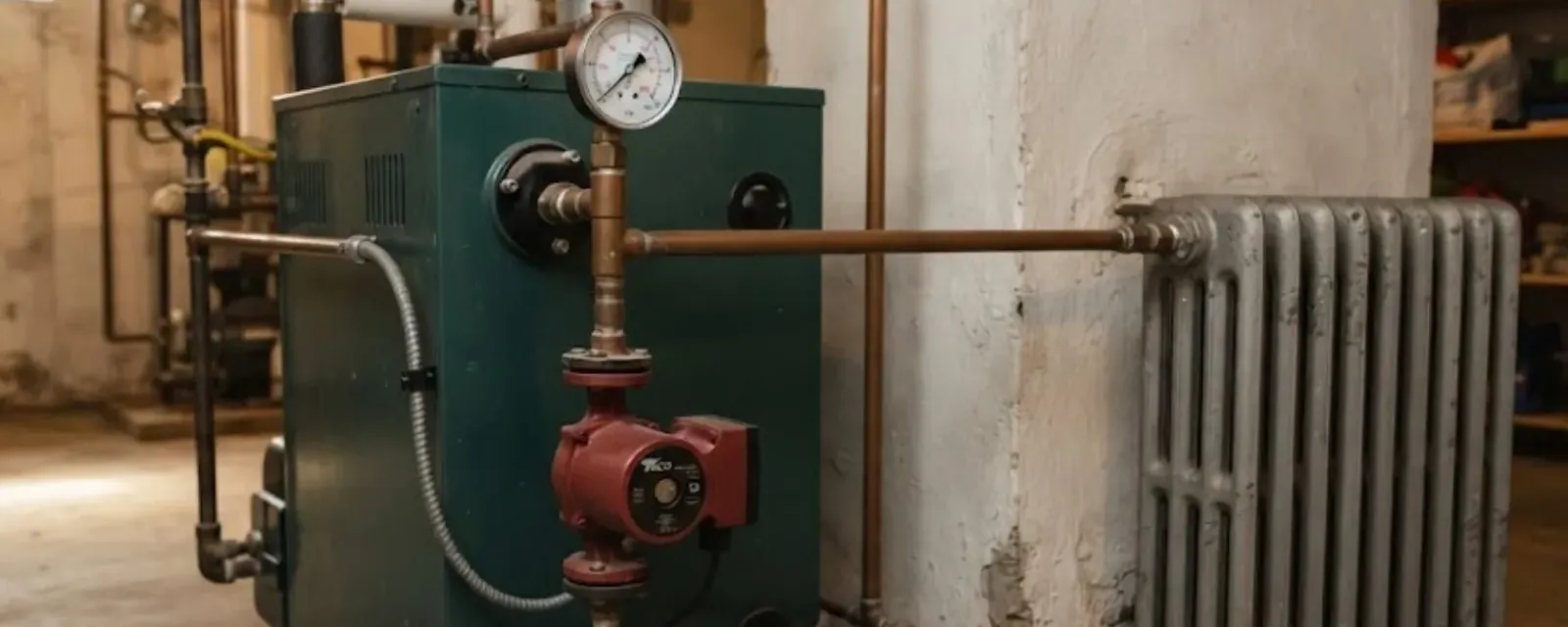
- Read the pressure gauge. A hot water boiler is typically around 12 to 15 pounds when cold, and the reading rises as the water heats. Tell the dispatcher what yours reads.
- Look for water around the boiler. A puddle moves the problem from comfort to damage.
- Do not press the oil burner reset button more than once. Repeated resets can flood the combustion chamber with unburned fuel.
Symptoms and likely causes
Different symptoms point to different parts. This guide helps you describe the problem.
| Symptom | Likely cause | Usual next step |
|---|---|---|
| Boiler runs but baseboards stay cold | Air in the lines or a circulator pump problem | Bleed the system or check the pump |
| Some rooms warm, others not | Air pocket or a zone valve problem | Bleed that zone, test the valve |
| Boiler will not fire | Fuel, ignition, safety control or power | Diagnosis at the burner or gas valve |
| Banging or kettle noises | Scale or sediment or air in the boiler | Flush or service the boiler |
| Pressure too high or too low | Expansion tank, fill valve or leak | Check the tank and the valve |
| Leak at the boiler | Failed relief valve, fitting or boiler body | Repair or replace depending on the source |
Oil, gas and propane: three fuels, three sets of rules
Heating fuel on the shoreline is mixed, and neighboring towns such as North Branford lean heavily on oil. The state's utility notes say that natural gas service in Guilford varies by street and that many homes use oil or propane. In neighboring Madison and Clinton, Census data show that more than half of occupied homes heat with fuel oil. For a homeowner, that means the boiler problem is often at the burner: nozzle, filter, ignition or the oil supply.
Gas piping and appliances in Connecticut follow NFPA 54 and NFPA 58 through the Fire Safety Code. Gas leaks and propane leaks are emergencies that come before the repair. Get everyone outside, then call 911 and Southern Connecticut Gas from there. The state lists its emergency line as 800-513-8898.
Licenses and permits for boiler work in Connecticut
Connecticut licenses heating work separately from plumbing. The Department of Consumer Protection lists heating, piping and cooling classes in the S series, with S-3 and S-4 covering the installation, repair, replacement and maintenance of piping, appliances and accessories for heating systems and boilers, along with oil and gas piping. Burner work has its own B classes, and gas piping and appliances have G classes. Ask whoever you hire which class they hold and check it on the state license lookup.
The Guilford Building Department lists boilers and HVAC as mechanical work, with its own permit type. It also lists removing an indoor oil tank as work that needs a plumbing sub-permit. Ask the contractor which permits your job needs and who files them.
Baseboard heat, bleeding and the water side
Air collects in hot water heating lines, and it blocks the flow of hot water to the farthest baseboards. Bleeding releases that air through small valves, and a boiler that refills with fresh water takes in more air. If one zone keeps losing heat, the fix may be a purging pass, an air separator or a circulator.
A boiler that feeds an indirect water heater supplies hot water too. When the boiler goes down in winter, the hot water goes with it. Our water heater repair page explains how the two systems relate.
Keeping pipes safe when the heat is out
If the boiler cannot be restored quickly in freezing weather, the priority is to keep the water in the pipes from freezing. Open cabinet doors on exterior walls, let a faucet drip, and consider draining pipes in unheated areas.
If you do find a frozen or split pipe, see burst pipe repair. The state code uses a frost depth of 42 inches, and the January average low at the coastal New Haven Tweed station is about 23 degrees Fahrenheit per NOAA, which means a hard freeze is not rare.
What affects the price of boiler repair
Repair prices depend on the part and the fuel.
- The part.A thermostat or zone valve is cheaper than a circulator, and a circulator is cheaper than a control or boiler section.
- The fuel and burner.Oil burners, gas valves and propane equipment differ.
- Age.An old boiler may cost more to repair than its remaining life justifies.
- Access.A boiler in a tight utility room takes longer.
- The hour.No-heat calls on nights and weekends are quoted as emergencies.
Insurance usually covers sudden water damage from a failed boiler or a freeze burst, and not the worn-out boiler itself. Photograph everything before cleanup.
No heat in the house?
Call the 24/7 line, say what the pressure gauge reads and whether there is any water around the boiler. If the house is below freezing, say that first.
Questions we hear on calls
Yes. A no-heat call in freezing weather is treated as urgent at any hour. Appointments depend on how many no-heat calls are open on a cold night, and the dispatcher says what is realistic.
Air in the lines or a circulator pump that has stopped is the common cause. A plumber can bleed the zone and test the pump.
Tell the dispatcher what fuel it uses. Burner and boiler work follows the state's heating license classes, so ask for the license class on the visit.
Occasional ticking is normal. Loud banging or kettle sounds suggest scale, sediment or air and need a visit.
Most manufacturers recommend yearly service. Check your boiler's manual.
It depends on age, efficiency and repair history. The plumber can compare.
Sources for the local details on this page
The local facts above come from the state's heating, piping and cooling license classes and Guilford Building Department permit page. Rules and figures can change, so check with the town or state office before you rely on them for a permit or a purchase.