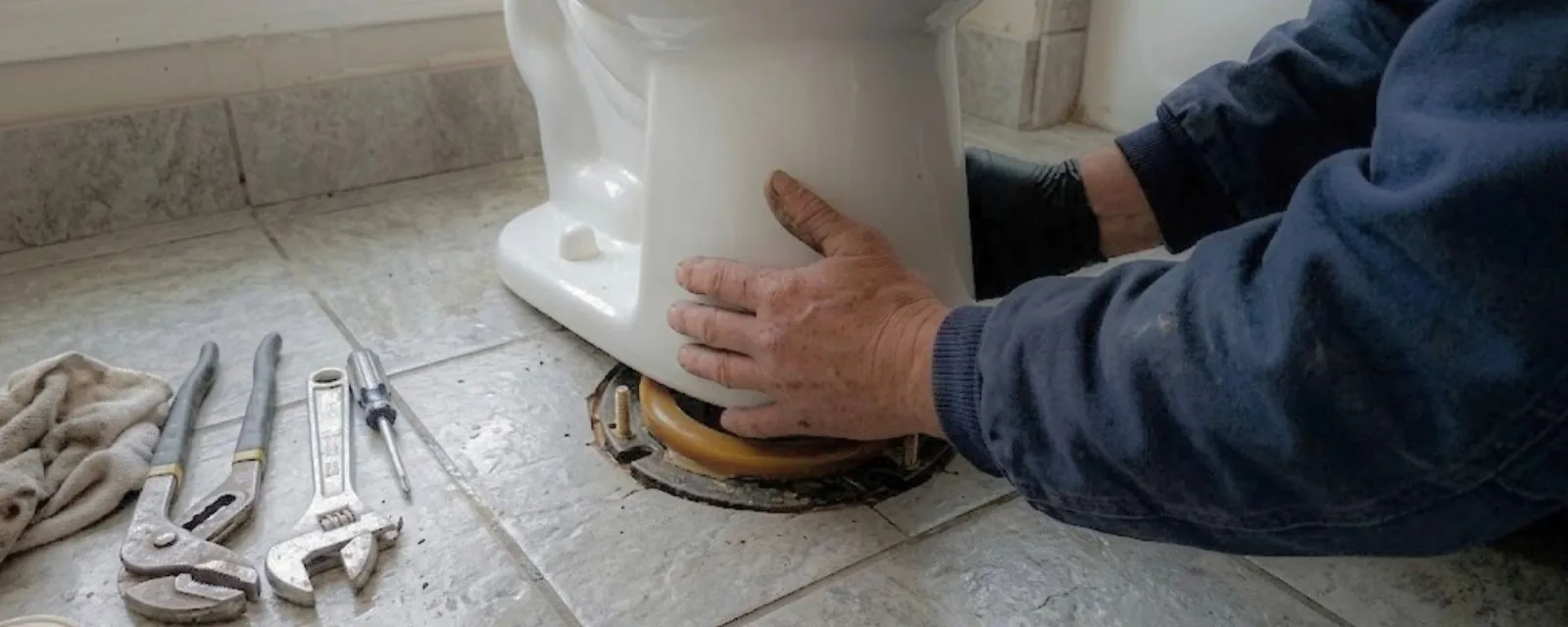
Find out where the water really comes from
Before you blame the seal, rule out the simpler causes. Wipe the floor, tank, supply line and bowl completely dry with a towel. Then check in this order, watching for the first bead of water.
- Tank sweat. On humid days a cold tank drips onto the bowl and floor. The water is clean and appears on the outside of the tank evenly, not at one point.
- Supply line and valve. Run a dry tissue around the valve at the wall and along the braided line. A wet tissue means a leaking fitting.
- Tank bolts and tank-to-bowl gasket. Look at the underside of the tank where it meets the bowl. Drips there run down the back of the bowl to the floor.
- The base. If water appears only after you flush, and at the bottom edge of the bowl, the seal is the suspect.
What each cause looks like and who fixes it
Use this table once you know where the first drop appears.
| Where the water appears | Likely cause | Fix | Homeowner or plumber |
|---|---|---|---|
| Whole outside of the tank, all surfaces | Condensation | Insulated tank liner, better ventilation | Homeowner |
| At the wall valve or along the supply line | Loose or worn fitting or line | Tighten or replace the line and valve | Either, plumber if the valve is stuck |
| Under the tank, behind the bowl | Tank bolt or gasket | Replace gasket and bolt washers | Either |
| At the base after flushing | Failed wax ring or seal | Pull the toilet and replace the seal | Plumber is the safer choice |
| At the base, toilet rocks | Loose bolts or damaged flange | Check the flange, reset the toilet | Plumber |
| Hairline crack in the porcelain | Cracked bowl | Replace the toilet | Plumber |
Guilford note: septic systems and permit rules for toilet work
Guilford has no municipal sewer, according to the town's plan of conservation and development, and the health department says sewage disposal is handled on-site by septic systems. A toilet that leaks at the base sends water to the floor, not to the tank, but a leaking seal can also let sewer gas into the house. A house on a septic system also has a tank that must be pumped every five years.
On permits, the state code lists resetting a toilet among work that does not need one, provided the pipes, valves and fixtures are not replaced or moved. If your repair turns up a failed drain pipe under the floor, replacing concealed drain pipe counts as new work under the same code section and needs a permit. The Guilford Building Department takes permit applications online and asks for a valid state license and liability insurance.
Why the seal fails
A wax ring sits between the bottom of the toilet and the closet flange, a ring screwed to the floor over the drain. It compresses to keep water and sewer gas from leaking out. It fails when the toilet rocks and breaks the seal, when the flange is set too low or cracked, or when the ring simply ages and hardens.
The first sign is often a faint sewer smell in the bathroom, before any water shows. A toilet that has leaked slowly for months can soften the subfloor around it. Press on the floor beside the bowl. If it feels spongy, the floor is already damaged and the repair is bigger than a ring.
Should you reset it yourself?
A handy homeowner can reset a toilet. It means shutting off the water, draining the tank and bowl, disconnecting the supply, removing the bolts and lifting a heavy toilet straight up. Wear gloves. Cover the open drain with a rag, since sewer gas rises and a dropped bolt can fall in.
Scrape off the old wax, check the flange for cracks, and set the new ring or a wax-free seal before lowering the bowl straight down and tightening the bolts evenly. Overtightening cracks the porcelain. Many people find the job easier than expected and the lifting harder.
Call a plumber when the flange is cracked or below the floor level, or when the floor feels soft. Call when the toilet is wall-hung or on a second floor above a finished ceiling, or when a leak might have reached the ceiling below. Our toilet repair service covers resets, flange repairs and replacements.
If the toilet is leaking right now
These steps limit the damage until a repair is made.
Close the supply valve
Turn the oval handle behind the toilet clockwise. If it will not turn, shut the main.
Stop using the toilet
Every flush adds water to the floor.
Mop and dry
Standing water soaks into subfloor and tile grout.
Check the ceiling below
A stain there means the leak has traveled and needs prompt attention.
Questions we hear on calls
Condensation appears all over the tank and is clean water that forms on humid days. A failed ring leaks at the base only after a flush, and the leak may come with a sewer smell.
Yes. Slow leaks can rot the subfloor and the framing under it over months. A soft spot beside the bowl is a sign.
Under the 2022 Connecticut State Building Code, the removal and reinstallation of water closets is exempt from a permit as long as the repair does not involve replacing or rearranging valves, pipes or fixtures. If the drain or flange has to be replaced, ask the Guilford Building Department.
Not usually. A rocking toilet means the flange or the floor is the problem, and a new ring will not hold.
No. Caulk hides the leak and traps water under the toilet. Fix the seal.
Sources for the local details on this page
The local facts above come from the 2022 Connecticut State Building Code, Guilford Health Department environmental health page and Guilford Building Department permit page. Rules and figures can change, so check with the town or state office before you rely on them for a permit or a purchase.