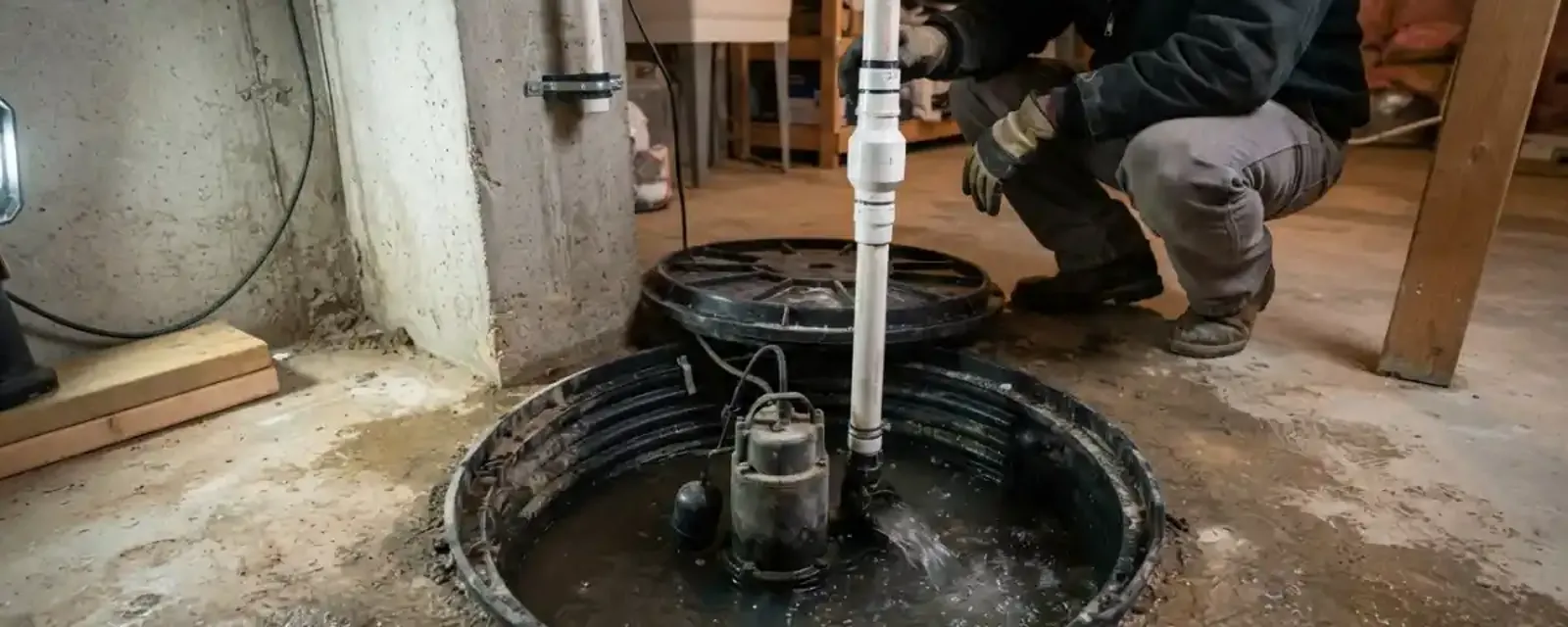
What goes into a sump installation
The pit and drains
A plumber breaks the slab, digs a pit about two feet deep and sets a basin in it. Perimeter drain pipes, if present, connect to the pit, so groundwater collects there rather than spreading across the floor. The pit gets a lid to keep out debris and reduce odor and humidity.
The pump
A submersible pump sits in the pit and switches on with a float. Pump power and capacity are matched to how much water the basement sees. Larger flows need a more powerful pump, and a second pump or battery backup protects against failure.
The discharge
The discharge line carries water out through the rim joist or wall to a point that slopes away from the foundation. It should have a check valve to stop water from running back into the pit and a freeze-resistant outlet.
Waterproofing options and what each one does
Choose by cause. Doing the wrong one wastes money.
| Option | What it does | Works best for |
|---|---|---|
| Sump pump with backup | Removes water that has collected | Basements that flood in storms |
| Interior perimeter drain | Collects water at the footing and sends it to the pit | Water rising through the floor joint |
| Exterior membrane and drain | Keeps water out of the wall | Water coming through foundation walls |
| Gutter and grading fixes | Moves roof and surface water away | Seepage tied to rainfall and downspouts |
| Crack injection | Seals a specific crack | Isolated cracks in poured walls |
| Waterproof paint | Surface coating | Minor dampness only |
Guilford note: septic setbacks, flood zones and rain totals
The Guilford Health Department's septic guidance says to keep sump pumps and house footing drains away from the septic system. Because the town has no municipal sewer, every house has a tank and a leach field somewhere on the lot, and a discharge pipe pointed at them can overload the field. Ask the plumber to locate the system before he places the discharge.
The town's Engineering Department says the Special Flood Hazard Area includes FEMA zones A, AE and VE and that many projects there need a Flood Hazard Permit. NOAA's 1991 to 2020 normals show about 42 inches of precipitation per year at the coastal New Haven Tweed station and about 50 inches at inland Mount Carmel, which gives a sense of how much water the ground sees.
Questions to ask before you hire
Good answers to these questions separate a lasting fix from a short-term one.
- Where does the discharge go? It should be away from the foundation and, in Guilford, away from the septic tank and field.
- Is there a backup? Storms cause outages, and a pump without power is a bucket.
- How is the pit sealed? A lid reduces humidity and radon entry.
- What about the water heater and furnace? Anything on the floor of a flood-prone basement is a candidate for raising.
- What happens if the pump fails? An alarm or a second pump limits the damage.
A plumber and a waterproofing contractor do different jobs
Plumbers install pumps, drain lines and the connections around them. Contractors who excavate and apply membranes work outside the foundation. Our sump pump service covers the pit and pump side, and our basement waterproofing page explains where plumbing ends and excavation begins.
If the water comes from a leaking pipe or a drain backup, the answer is not a pump at all. Rule that out first with leak detection.
Test your sump pump this weekend
A quick test tells you whether the pump will work when it is needed.
- Open the pit lid and look. The pit should be clear of debris and the float should move freely.
- Pour in several gallons of water. The float should rise and the pump should start.
- Watch the pump empty the pit. It should shut off when the water drops.
- Check the discharge outlet outside. Water should flow and the outlet should be clear.
- Test the battery backup if you have one. Unplug the pump to simulate a power loss and see whether the backup runs.
Battery backups and their limits
A battery backup pump runs on a deep-cycle battery and a charger. It keeps the basement dry through an outage for hours, depending on the battery size and how hard the pump is working. It is not a replacement for the main pump or for fixing the cause of heavy water. Batteries wear out and need replacing every few years.
Some homes use a water-powered backup that runs on pressure from public water. It needs no electricity or battery, but it uses water while it works and it does not suit a house on a private well.
Keeping the system working
Test the pump every few months and before the wet season. Clean the pit if silt or gravel has collected. Check that the check valve clicks when the pump stops. Make sure the discharge pipe is not blocked by ice, leaves or a collapsed section.
If the pump runs far more often than it used to, the water table may have risen or the check valve may be failing and letting water fall back. A plumber can tell which. For a wet basement with other causes, see how waterproofing and plumbing fit together.
Questions we hear on calls
Typically around two feet, but the plumber sizes it to the pump and the water table at your house.
Not necessarily. A basement in a low area or near wetlands may see water only in the wettest year. A moisture history helps decide.
No. The Guilford Health Department's septic guidance says to keep sump pumps and footing drains away from the septic system. Discharge outside, away from the tank and the field.
The town says work on structures in the Special Flood Hazard Area can require a Flood Hazard Permit, and that work needing only a mechanical permit does not. Ask the Engineering Department which applies to your address.
A straightforward replacement takes a few hours. A new pit with a cut slab and perimeter drain takes a day or more.
Yes. See the pages for North Branford and Clinton for what their town records say about flooding.
Sources for the local details on this page
The local facts above come from the town's septic system brochure and Guilford Engineering Department flood hazard permit page. Rules and figures can change, so check with the town or state office before you rely on them for a permit or a purchase.