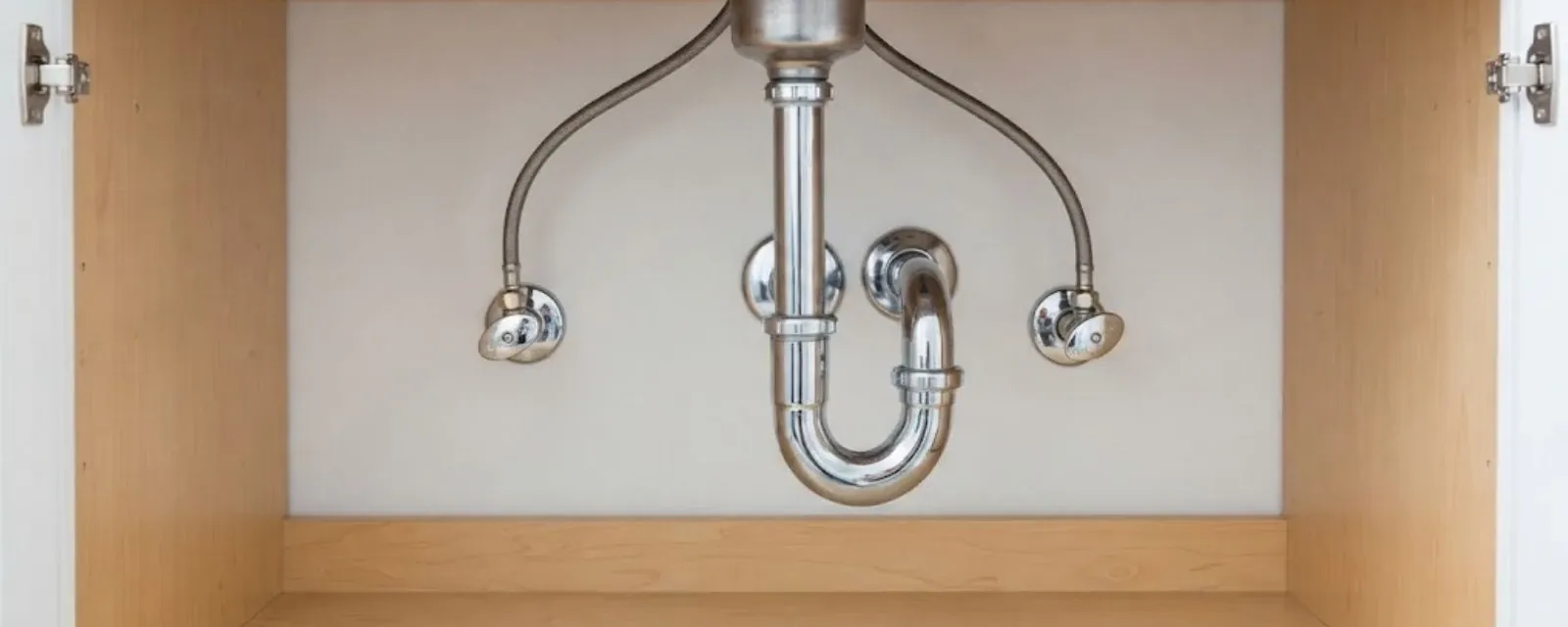
Every part, in order from the faucet to the wall
Supply side first, then the drain.
| Part | What it does | How it fails |
|---|---|---|
| Faucet and cartridge | Controls flow and temperature | Drips or leaks at the handle |
| Supply lines (braided) | Carry water from the stops to the faucet | Corrode, kink or burst at the fittings |
| Shutoff valves (stops) | Let you isolate the sink | Seize or leak at the stem |
| Strainer or sink flange | Catches debris at the drain opening | Leaks where it seats on the sink |
| Tailpiece | Short pipe below the strainer | Cracks or loosens at the nut |
| P-trap | Holds water that blocks sewer gas | Clogs, leaks at slip joints |
| Trap arm | Slopes to the wall drain | Sags, collects debris |
| Wall stub-out and vent | Connects to the house drain and lets air in | Blockage, vent problems |
The supply side
Water enters the sink area through two small shutoff valves in the wall or floor. Hot is on the left, cold on the right. Short flexible lines connect each valve to the faucet. Replacing these lines when you replace a faucet is standard practice. Shutoff valves that have not been turned in years often will not seal after they are moved.
If a supply line or valve leaks, shut off the main valve and call. Faucet and valve repair covers these parts.
Guilford note: what goes down a septic-connected drain
The town of Guilford has no municipal sewer, and every sink drain in town leads to a septic tank. The tank holds solids and lets liquid flow to a leach field. The health department says all septic systems must be pumped every five years, and some areas are inspected yearly. A drain that dumps grease or heavy solids into the tank shortens that cycle.
The town's guidance for homeowners also includes not backwashing water softeners into the septic system, which matters if you have a softener plumbed under or near the sink. Permit rules for sink work follow the state code, which exempts leak repairs that do not replace or rearrange pipes, valves or fixtures.
The drain side
The sink drain starts at the strainer. A tailpiece drops straight down to the P-trap, a U-shaped bend that holds a plug of water. That water is the barrier that keeps sewer gas out of the room. The trap arm leaves the trap and slopes slightly to the wall, where the drain pipe continues to the house line.
Traps catch rings, jewelry and clumps of hair, which is the reason to look there first when a drain clogs. The slip nuts that hold the trap can be undone by hand or with pliers. Put a bucket underneath. For deeper clogs, our drain cleaning service clears the line beyond the trap.
Common problems and which part is the cause
Each of these has a quick check.
- Water pooling under the sink. Dry everything, run the tap, then check the supply fittings and the drain slip nuts one at a time.
- A gurgling drain. A partial blockage or a vent problem. The trap seal can also be pulled by suction.
- A sewer smell from the sink. A dry trap, a cracked trap or a missing vent.
- Slow draining. Debris in the trap or buildup in the pipe beyond it.
- A faucet that drips. A worn cartridge or washer.
Replacing a P-trap, step by step
This is one of the easiest drain repairs for a homeowner.
- Put a bucket under the trap. It will hold a cup or two of water and sludge.
- Loosen the two slip nuts. Turn them counterclockwise by hand or with pliers.
- Remove the old trap and clean the threads. Check the washers for cracks.
- Fit the new trap with new washers. Tapered side of the washer faces the fitting.
- Tighten the nuts snugly. Hand tight plus a quarter turn is usually enough.
- Run water and look for drips. Dry the joints with a towel and check again after a minute.
Plastic or metal: which trap to buy
Plastic traps are inexpensive, do not corrode and are easy to cut and fit. Chrome-plated brass traps look better where they are visible under a pedestal sink and last longer under heavy use. Either works. What matters is the size, usually one and a quarter inches for bathroom sinks and one and a half for kitchens, and the quality of the washers.
Avoid mixing materials at a threaded joint without the right adapter, and avoid corrugated flexible traps in places where they can sag. A sag is a place for waste to collect.
Double bowls, disposals and dishwashers
A kitchen sink with two bowls shares a trap through a tee fitting, and a disposal adds a second connection. The dishwasher drain hose connects to the disposal or to a tailpiece branch and should loop high before it drops, so waste cannot flow back into the machine. A slow double sink usually points to a partial blockage past the tee. See disposal repair if a unit is part of the setup.
If you are not sure how your sink is plumbed, take a photograph of the cabinet before you disconnect anything. It saves a lot of guesswork at reassembly.
Questions we hear on calls
It is the P-trap. It holds water that keeps sewer gas from entering the room.
A dry trap, a debris coating in the trap or a venting problem. Run water for a minute and check the trap.
Yes. Slip nuts tighten by hand and the parts are inexpensive. Match the pipe size, usually one and a quarter or one and a half inches.
The state code exempts repairs of leaks in pipes, valves or fixtures that do not involve replacing or rearranging valves, pipes or fixtures. Replacing concealed pipe in a wall counts as new work. Ask the building department about your case.
No. The drain parts are the same. What changes is what you should send down the drain, because the tank has to digest it.
Sources for the local details on this page
The local facts above come from the Guilford Health Department environmental health page and 2022 Connecticut State Building Code. Rules and figures can change, so check with the town or state office before you rely on them for a permit or a purchase.