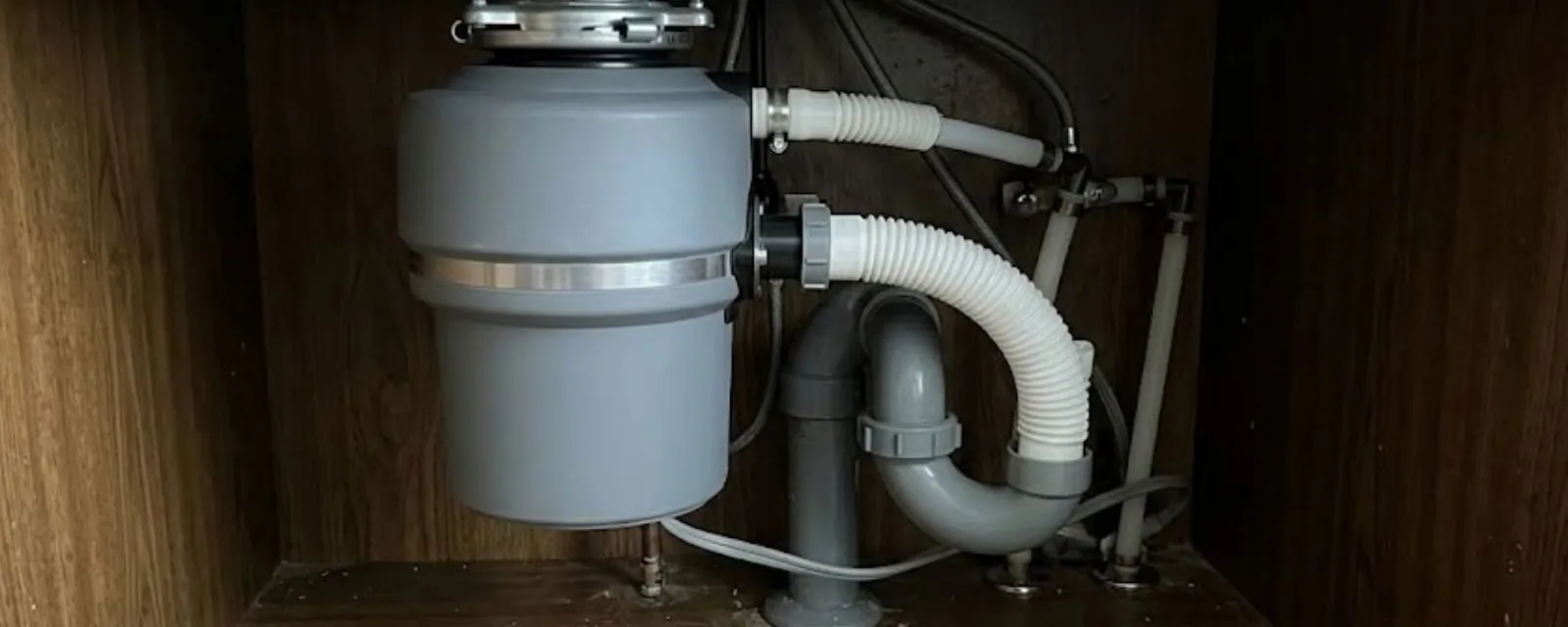
How a double sink drain is laid out
Each basin has a strainer and a tailpiece. Without a disposal, the two tailpieces join at a tee, and a single trap serves both. With a disposal, the disposal mounts under one basin and its outlet connects to the tee. The other basin drains through a tailpiece that joins the same tee. The trap arm then leaves toward the wall.
The disposal has a side port for the dishwasher drain. A plastic knockout plug blocks that port until you open it. If it is not removed, the dishwasher cannot drain, a mistake that sends dishwater back into the machine.
Parts and tools list
Gather everything before you start. A second trip with the sink torn apart is the usual cause of a lost weekend.
| Item | Purpose | Note |
|---|---|---|
| Disposal unit with mounting kit | Grinds waste and mounts to the sink | Choose motor size to suit use |
| Power cord or hard-wire kit | Supplies electricity | Needs a switched outlet or a switch |
| Discharge tube and gasket | Connects the unit to the drain | Match to the unit |
| Tailpiece and continuous waste | Joins the second basin to the tee | Size usually one and a half inches |
| P-trap | Holds the water seal | Reuse if sound, replace if cracked |
| Dishwasher drain hose and clamp | Connects the machine | Knock out the plug first |
| Plumber's putty and screwdrivers | Seals the flange | Press, do not smear |
Guilford note: disposals, septic tanks and who is licensed
Every Guilford house has an on-site septic system, because the town has no municipal sewer. A disposal grinds food into small particles that add to the solids settling in the tank. The health department's five-year pump-out requirement applies whether or not you use one, and Connecticut Water's water quality report advises inspecting septic tanks every two years.
On licensing, the state's Department of Consumer Protection says people doing electrical, HVAC, plumbing, heating and similar jobs must have the appropriate Connecticut license. The Guilford Building Department asks for a valid state license and liability insurance when a contractor applies for a permit, and it handles plumbing and electrical permits as separate types.
The order of the work
This sequence keeps the sink usable as long as possible.
- Turn off power and water. Switch off the circuit and close the stops under the sink.
- Remove the old drain parts. Take off the trap, tailpiece and old strainer.
- Mount the sink flange. Seat it on a rope of putty and tighten the mounting ring.
- Hang the disposal. Lift it onto the mount and lock it into place.
- Connect the discharge tube and the second basin. Adjust the pipes so they slope down to the tee.
- Attach the dishwasher hose. Knock out the plug and clamp the hose, looping it high.
- Wire it and test. Restore power, run water and check every joint for drips.
Where installations go wrong
The common errors are a missing slope in the drain, a dishwasher plug left in place, a flange that was not sealed and a power connection made without a switch. A disposal that leaks at the top has a failed flange seal, one that leaks at the side has failed internally. For repair of a unit that is already installed, see garbage disposal repair.
If the second basin fills when the disposal runs, the line beyond the tee is partly blocked. That is a drain cleaning job, not a disposal problem.
Who is allowed to do the electrical part
Connecticut says people doing electrical, plumbing, heating and similar work must hold the appropriate Connecticut license. A homeowner doing work in their own house is a separate question that the state statute addresses, and this guide does not state what it permits. If the electrical connection is not simple, ask a licensed professional.
A plumber who installs a disposal either does the wiring where the license allows or brings in an electrician. Ask which, and who is responsible for the permit if one is needed.
Choosing a disposal: motor size and features
Disposals are rated by horsepower, and the usual range for a home is one-third to one horsepower. A larger motor grinds tougher waste, runs more quietly and jams less often, but it costs more. A household that cooks often and scrapes plates into the sink benefits from a stronger motor. A two-person home with light use gets by with a smaller unit.
Look at the grinding stages, the sound insulation and the warranty. Continuous feed models run while you hold a switch and batch feed models run only with the stopper in place. A batch feed model is a safety choice for homes with children, since it cannot run with a hand in the drain.
Maintenance that keeps a disposal working
A few habits extend its life and prevent clogs.
- Run cold water while it runs and for 15 seconds after. Cold water keeps grease solid so it is chopped and flushed.
- Feed it small amounts. A pile of scraps jams more easily than a trickle.
- Keep fibrous and starchy foods out. Celery strings, potato peels and rice swell and clump.
- Never pour grease into it. Grease coats the pipe beyond the disposal.
- Clean the baffle and flush with ice and citrus peel sometimes. Dislodges residue and freshens it.
Questions we hear on calls
Usually. You need room under the sink, a standard drain opening and a power source. Describe the cabinet and the drain to the plumber.
The tee or the line beyond it may be partly blocked or sloped wrong. The disposal pushes more waste into it.
The hose needs a high loop or an air gap to prevent backflow. A plumber checks that on any installation.
It adds solids to the tank. Guilford requires pumping every five years, and a heavy disposal user may need it sooner. Ask your pumper.
Permit rules vary. The state code exempts leak repairs that do not replace or rearrange pipes, valves or fixtures, but adding a new appliance with electrical work may differ. Ask the Guilford Building Department.
Sources for the local details on this page
The local facts above come from the state's plumbing license classes and Guilford Building Department permit page. Rules and figures can change, so check with the town or state office before you rely on them for a permit or a purchase.